

Corner capital or element of a multiple capital: Two siren-harpies surrounding a haloed figure
France, Champagne, circa 1170–1180
Provenance
Study
The inverted bell form of the capital is circular at the base and flares as it rises, ending in a quarter circle. A siren-harpy is carved in substantial relief on each of the principal sides of the capital, one with the head of a bearded man, the other with that of a woman with a long tress of hair. The projecting corner of the capital bears the image of a standing haloed figure, its head unfortunately missing.
The very high quality of carving, still perceptible in spite of being so impaired, as well as its style and iconography, allow this capital to be compared with the sculptures of the important group of dispersed elements from the cloister of Notre-Dame-en-Vaux in Châlons-en-Champagne.
An essential element of the history of Early Gothic art, this immense cloister, superbly decorated with historiated capitals and column statues, spread out from the north side of the church of Notre-Dame-en-Vaux, in the north-east area of Châlons-en-Champagne. The structure disappeared during the eighteenth century when the impoverished canons and parishioners, who were responsible for its maintenance, could no longer bear the expenses. On 10 May 1754, the building committee thus decided to “demolish three sides of the cloister, leaving the fourth, which was situated alongside the said church of Our Lady”.1 But on 5 February 1764, it was decided to also sacrifice the south gallery. Part of the demolished material was repurposed in situfor new construction, while part was sold and dispersed. Even though there was an awareness in the late nineteenth century of some pieces with a provenance from this cloister, it was only after excavations carried out in the 1960s and 1970s that the importance of the sculpture of Notre-Dame-en-Vaux was fully appreciated.2 Strongly resembling monumental sculpture in the Île-de-France and the clear influence of Mosan art,3 the cloister sculptures are the work of several masters. Their style indicates a relatively early date during the second half of the twelfth century. However, the ensemble would certainly have been completed when the church received its Episcopal benediction in 1183.
In spite of the numerous studies focusing on the sculptures of Châlons-en-Champagne, the capital formerly in the Guiraud collection has never been identified until now as coming from the cloister group. Although there is no documentary proof to support this identification, the limestone material and above all the style and quality of the sculpture are close enough to the cloister’s surviving elements to enable us to put forward this provenance.
The specific form of this capital, which at first sight might appear to belong to a corner capital, is more likely instead to have come from a multiple capital. Perhaps it was of the type found in a quintuple capital still at Châlons, which also has chimeras composed of creatures with the body of a bird and the tail of a reptile.4 The projecting point of the capital, with a haloed figure whose face is missing, can clearly be recognised as female, given the presence of a long tress of hair still visible on the left side. She wears a robe belted at the waist, and the finely-pleated long sleeves under the larger sleeve of her ample cloak, of which she lifts a fold with her right hand, while holding its other end in her left. The cloak is trimmed with a fine carved orphrey, showing the same kind of attentive crafting we see on some of the column statues in the cloister. The careful carving of the long braid on the female figure, and the painstaking, delicate handling of the wings, attached to the creature’s paw by a collar adorned with a festoon, reveal the same attention to ornamental detail.
The creature with a male head, better preserved than the female one, is no doubt the element that most strongly favours an attribution of our capital to the Châlons-en-Champagne group.
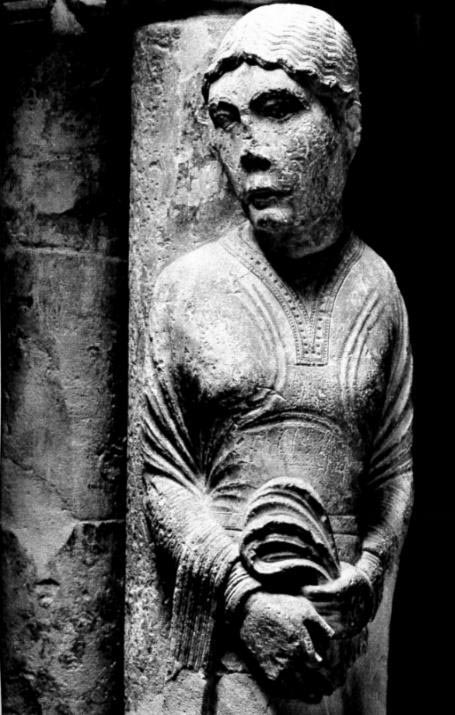

Column statue, cloister of Notre-Dame-en-Vaux, Châlons-en-Champagne.
Column statue, cloister of Notre-Dame-en-Vaux, Châlons-en-Champagne.
Apart from the audacious openwork cutting of the neck, the highly individual treatment of the face is especially notable. Parallels can be found between the delicate striated and curled locks of hair and those on some of the column statues or historiated capitals originally in the cloister. Likewise, the bulging eyeballs, set between eyelids defined by two fine rolls, as well as the structure of the face, with its high cheekbones and delicate modelling, recur on several of the male heads in the cloister decoration.
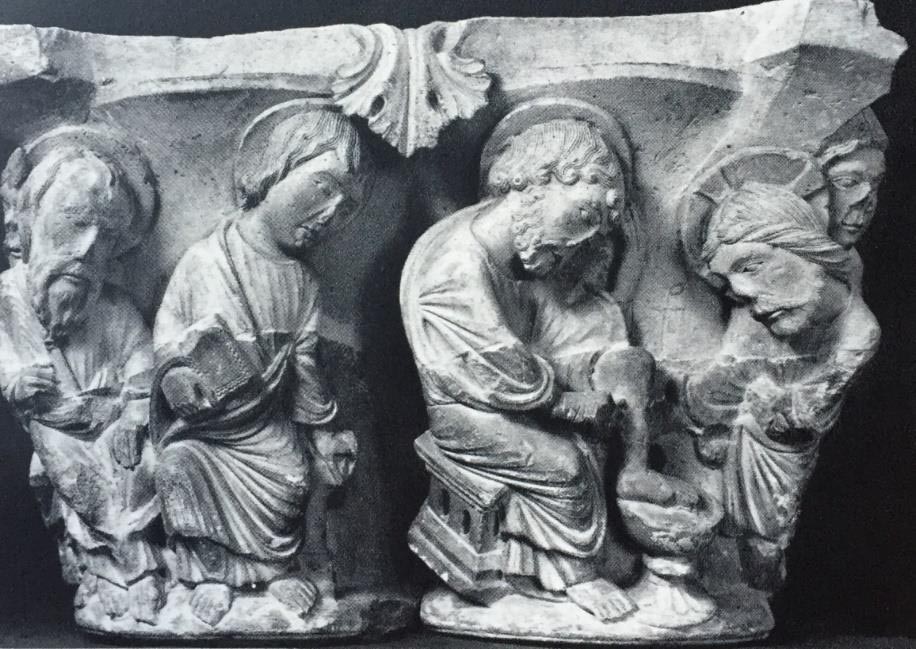
Double capital, The Washing of the Feet, Cloister of Notre-Dame-en-Vaux, Châlons-en-Champagne.


Multiple capital, The Marriage at Cana (detail), Notre-Dame-en-Vaux, Châlons-en-Champagne.
Finally, the subtle modelling of the smooth surfaces of the bodies of these two chimeras, both on the necks and in the coiling of the tails shows the same sculptural tension as found in passages of drapery on the figures surviving today at Châlons-en-Champagne.
Archives départementales de la Marne, G.722, fol. 107-108, cited in Pressouyre, L., Un Apôtre de Châlons-sur-Marne, Berne, 1970, p. 5.
Pressouyre, S., Image d’un cloître disparu, Notre-Dame-en-Vaux à Châlons-sur-Marne, Meudon, 1976.


