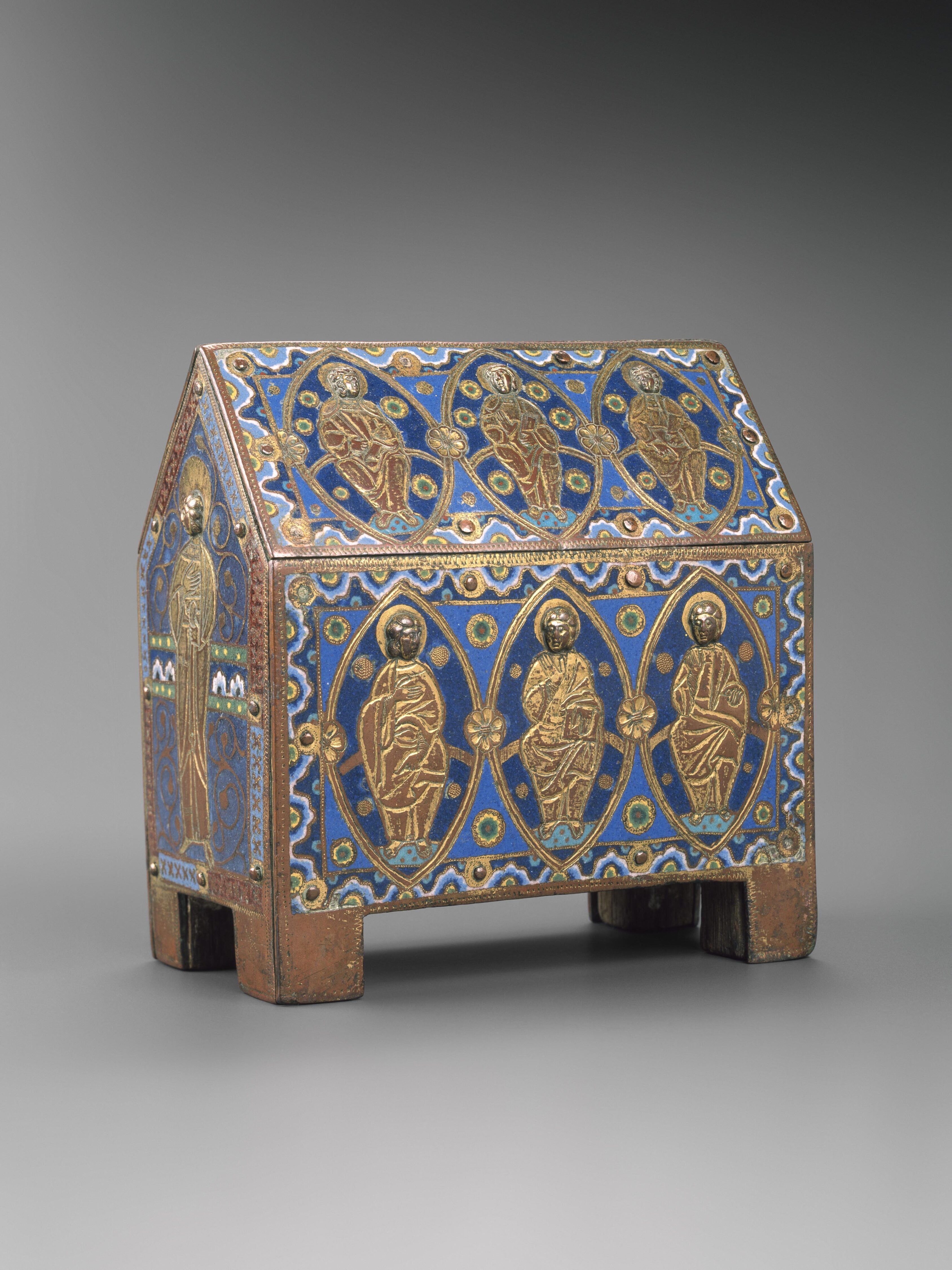
Reliquary chasse with Apostles
Limoges, circa 1190-1200
Provenance
Joseph Homberg collection (sale, London Sotheby’s, 19 July 1949, lot 156); acquired by Pierre Dormeuil [1887–1976]; Dormeuil collection.
Literature
Gauthier, M.-M., Antoine, É and Gaborit-Chopin, D. (eds.), Corpus des émaux méridionaux, II, L’apogée 1190–1215, Paris, 2011, I E 4, nº24.
Study
The front face of this reliquary chasse bears the same general composition on the case and roof: a row of three mandorlas joined horizontally by engraved rosettes, each enclosing the figure of a saint or apostle seated on a golden arc, their feet resting on a dotted turquoise band. The deeply engraved reserved gilt figures on the front and gable ends have classicizing heads in half relief.
The great simplicity of the iconography does not preclude an appreciation of the superb quality of this chasse, the subtlety of its decoration and colours, as well as the true originality of the ornamental language. Indeed, as Simone Caudron,1 has pointed out, this reliquary chasse has certain motifs which are rather uncommon among Limoges chasses, such as the blue and white cloud forms that surround the row of plaques on the principal face, or the green bands that cross the gable ends. The ends themselves show an equally original approach in the grand, slender standing figures of saints, their appliqué heads standing out from very large haloes, simply reserved and gilt. The fine reserved foliate motifs accompanying these figures are also unusual. Likewise, the back of the chasse has an original form of decoration, with quatrefoils enamelled in pale blue and white, inscribed within gilt discs set in a network of squares connected by green-enamelled dots in the interstices. This manner of organizing the decoration recurs on the very fine chasse formerly in the collection of J. Pierpont Morgan now in the Metropolitan Museum of Art.2 This belongs to a small group of chasses containing certain features that rarely occur in the decorative repertory of Limoges, and which have been dated to between 1185 and 1200. A notable piece which can be associated with this group is the chasse formerly in the Durand collection, now housed in the Musée du Louvre,2 where foliage accompanies the figures of standing saints. Notwithstanding the parallels one could draw with the chasses in this group it seems hard to make a connection with the chasse formerly in the Dormeuil collection, which probably belongs to a slightly later period, around 1200. That being said, the present reliquary chasse seems to fit perfectly in the wake of that group, and bears witness to the significant variants and original creative exploration made by Limousin workshops in the years before they evolved into a more streamlined output.
M.-M. Gauthier, É. Antoine and D. Gaborit-Chopin (eds.), Corpus des émaux méridionaux, tome II, L’Apogée, 1190-1215, Paris 2011, 1 E 4, no. 24.