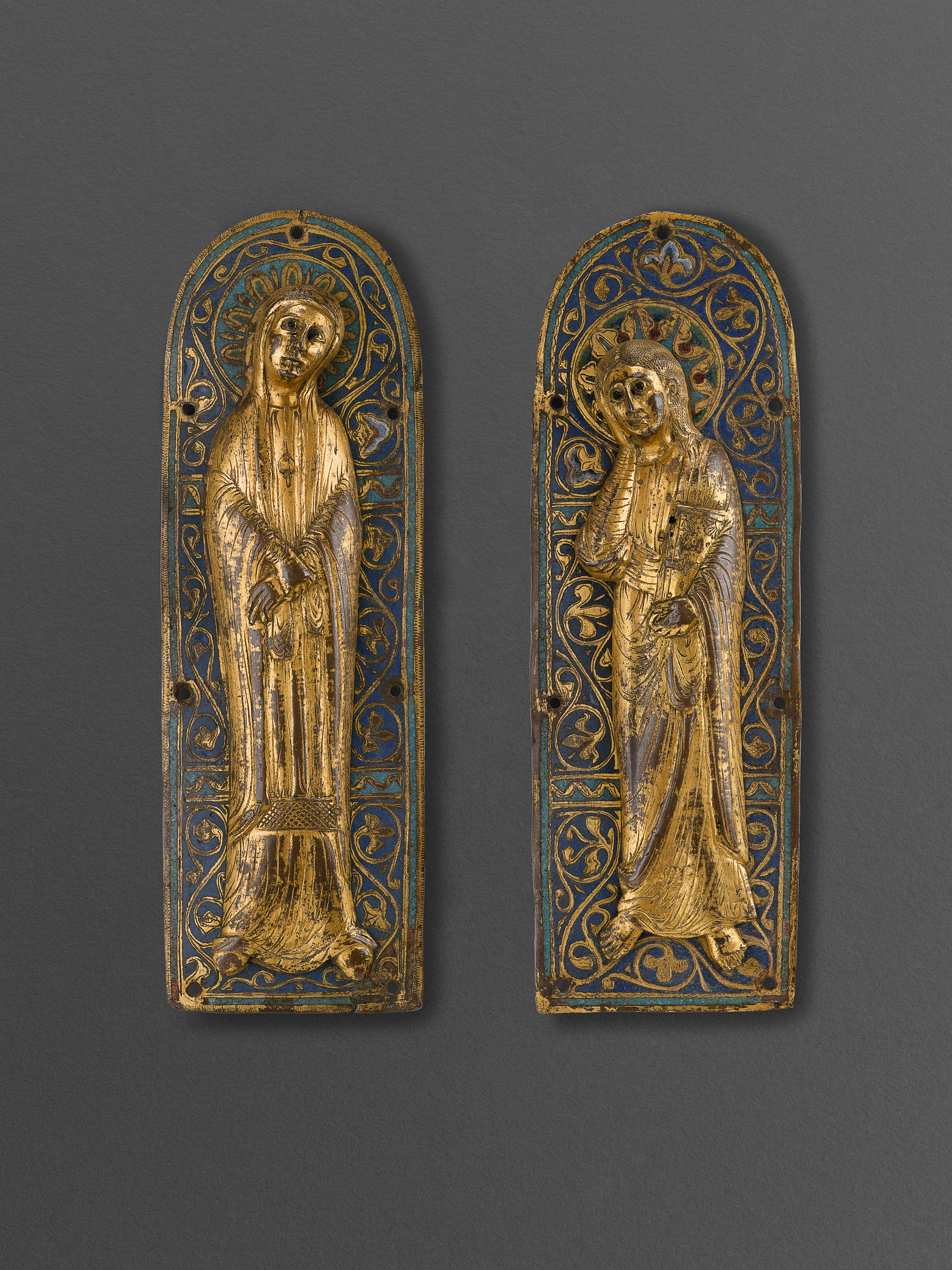
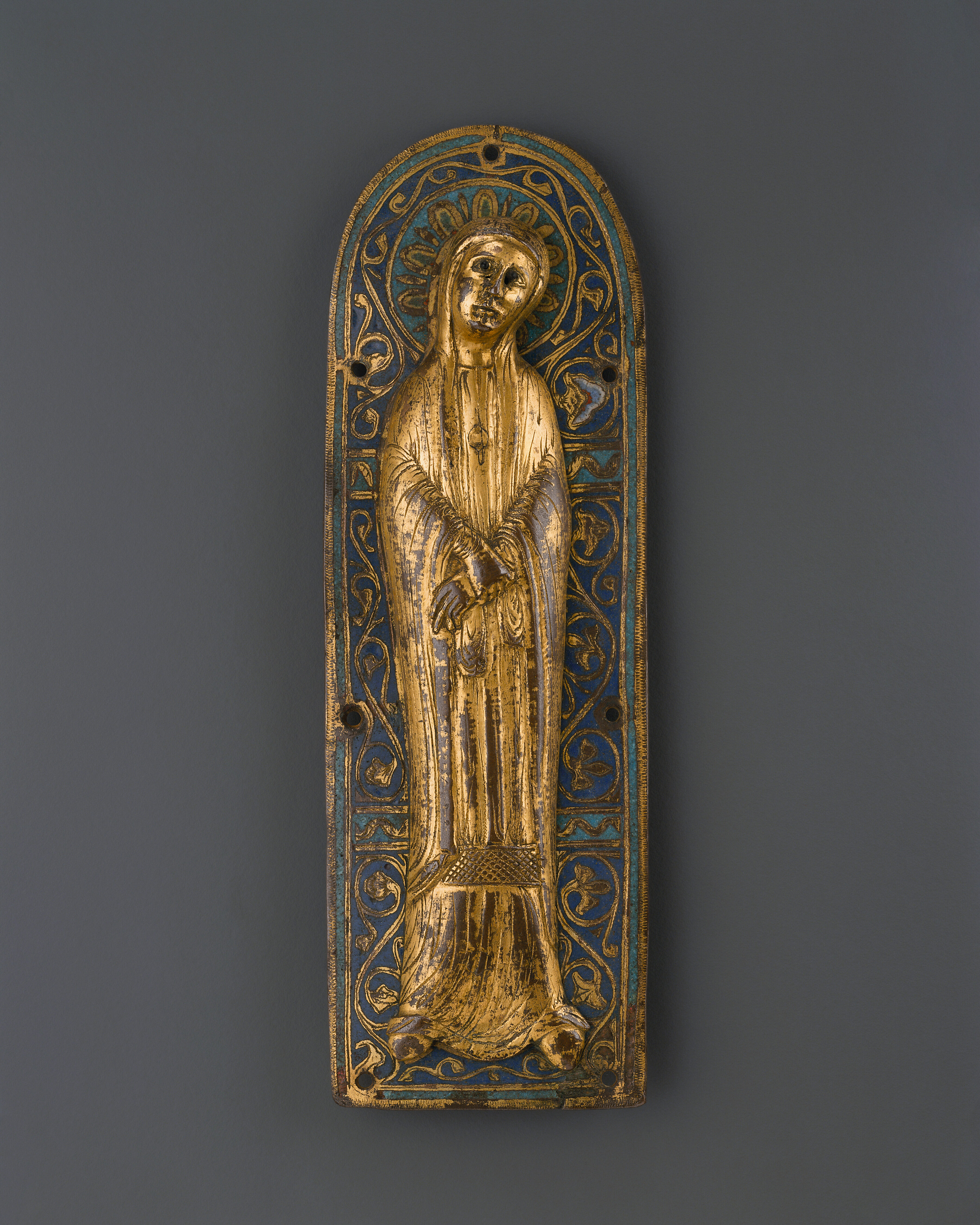
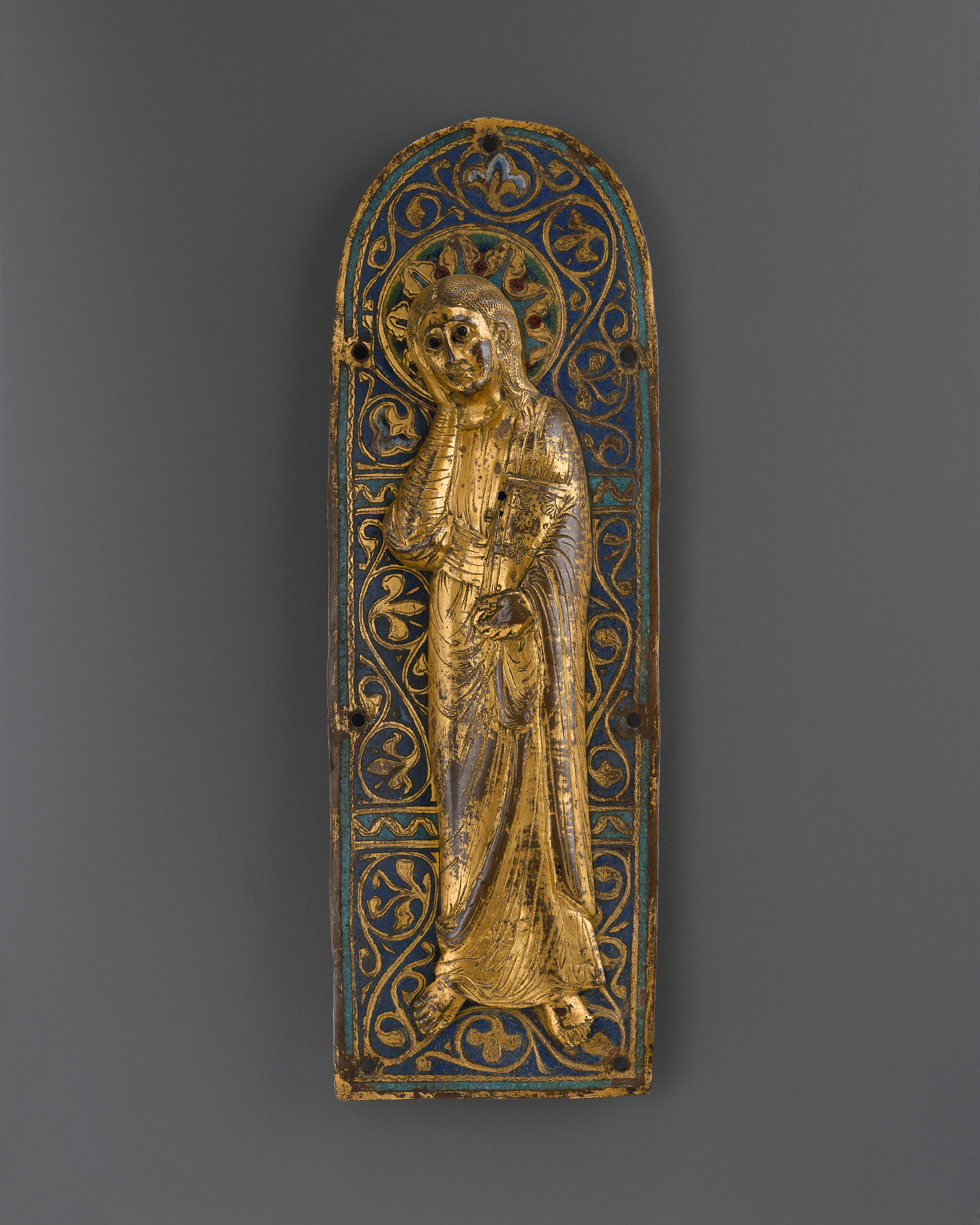
Two plaques: The Virgin and Saint John at Calvary
Limoges, circa 1230
Copper: engraved, chased and gilt; champlevé enamel
Provenance
Acquired at Brimo de Laroussilhe in 1929 by the collector François Baverey (Lyon).
Literature
Bertrand, É., Émaux limousins du Moyen Âge. Ière Partie : Essai d’un inventaire des émaux limousins du moyen âge, négociés par Brimo de Laroussilhe depuis 1908, Brimo de Laroussilhe, Paris, 1995, fig. VIII p. 16, nº124, p. 70.
Study
These two standing figures are easily identifiable as the Virgin Mary and Saint John the Evangelist at Calvary, flanking the Crucifixion. The Virgin is veiled and her head leans to one side; she holds her wrist in a sign of anguish, while Saint John holds the Book in his left hand and raises his right to his face.
Both of these appliqué figures, crafted in repoussé copper that was engraved and chased, is attached to an enamelled plaque by two rivets which are engraved and gilded like the rest of the figure. The enamelled gilt plaques are arched at the top and have a reserved gilt inner border surrounded by a thin band of turquoise enamel. The outer contour of the plaque with the Virgin is engraved with zigzag hatching which does not appear on the plaque with Saint John. The foliate motifs adorning the backgrounds of both plaques branch out into flowers, only the upper ones enamelled. Two horizontal bands of turquoise enamel, decorated with a reserved and gilded wavy line, cross each plaque below the shoulder level and behind the knees of each appliqué figure. Their two haloes are different, one in turquoise enamel, adorned with lobe-shaped rays, punctuated on the plaque with the Virgin by reserved gilt lines, whereas that with Saint John is more colourful, with a more complex motif of lobed rays punctuated by red enamel dots.
This pair of enamelled plaques show a clear evolution towards less refined handling, both in the engraving, with its less than regular outline, and in the palette and content of the enamel, which not only have a duller tonal range but a greater material opacity and a more subdued appearance than in works of the preceding period. This more loosen style of enamelling corresponds perfectly to works produced from the second quarter of the thirteenth century onwards, which coincides with the appearance of new procedures in the crafting of enamel.1
The treatment of the appliqué figures is also characteristic of this period, in particular Saint John’s hair, with its fine lines of parallel stippled undulation. The drapery folds, sometimes only sketched out, are rendered with somewhat irregular lines, in places only summarily engraved. These varied characteristics allow us to compare our two plaques with the appliqué figure of a Saint, now isolated, in the Metropolitan Museum of Art,2 as well as the Chasse of Saint Fausta in the Musée de Cluny 3, both datable to about 1230. We can also imagine these two plaques originally flanking a figure of Christ on the cross, on a large reliquary of that type, or like the Saint-Viance reliquary, on which appliqué figures are also attached to independent arched plaques4.
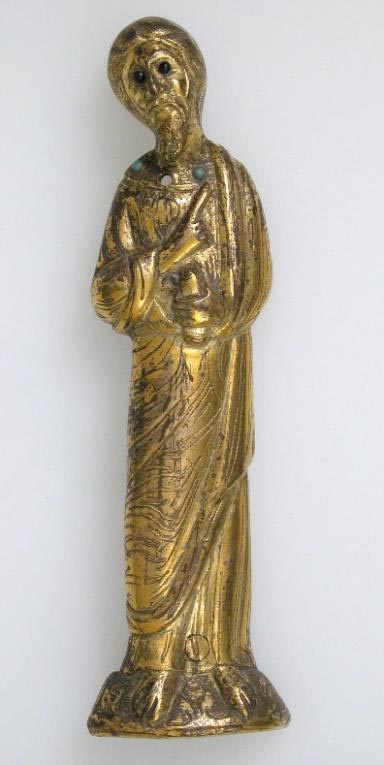
Appliqué figure, Limoges, circa 1230. New York, The Metropolitan Museum of Art.
See “Techniques and Materials in Limoges Enamels”, in É. Taburet-Delahaye and B. Drake Boehm (eds.), Enamels of Limoges, 1100–1350, exh. cat. (Paris, musée du Louvre, October 23th, 1995–January 22nd, 1996; New York, The Metropolitan Museum of Art, March 4th–June 16th, 1996), New York, 1996, pp. 48–62.