Lippo Vanni
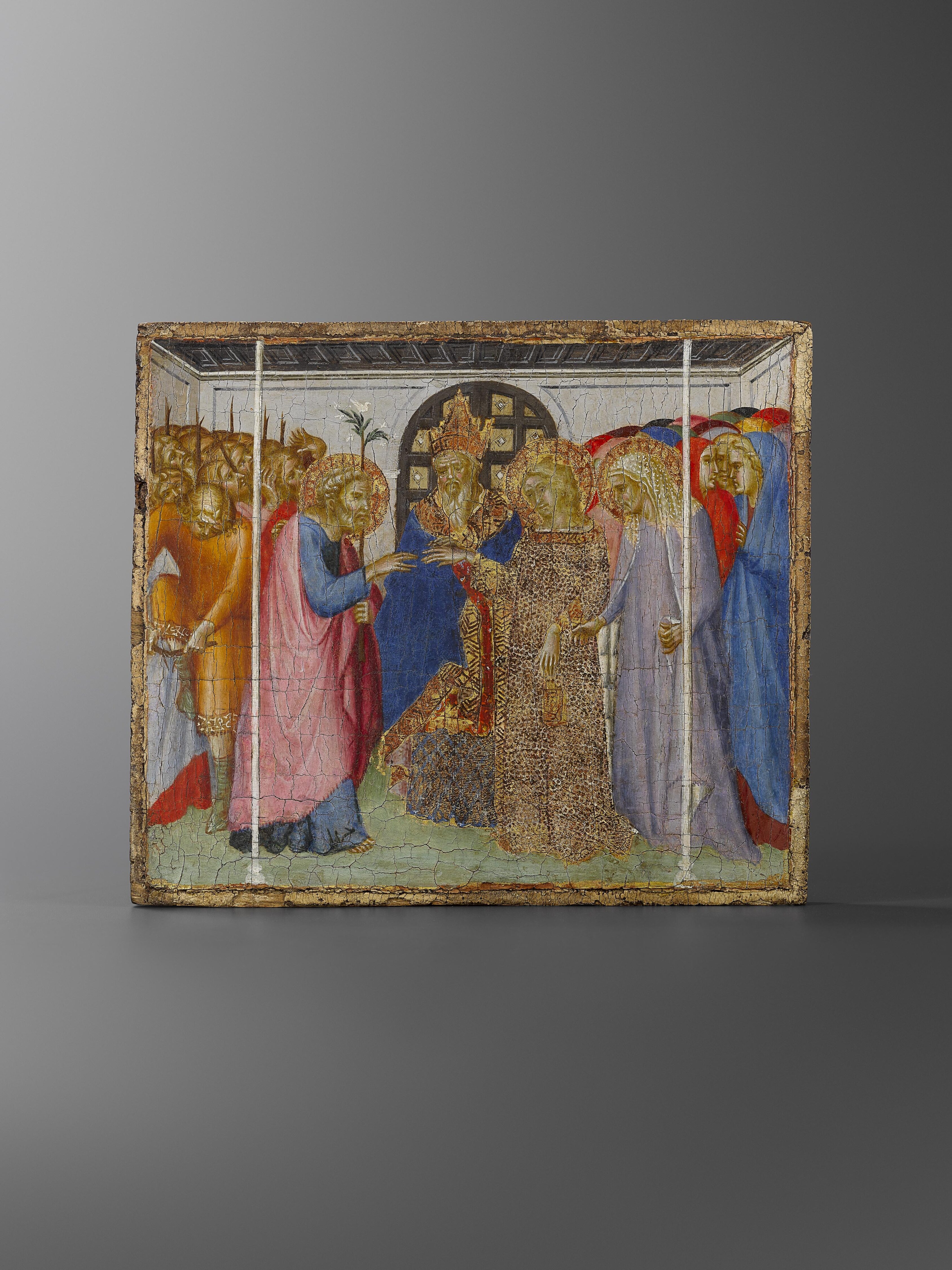
A predella panel: the Marriage of the Virgin
Siena, circa 1345
Provenance
Collection of Walter Savage Landor [1775-1864], Villa Gherardesca, Fiesole.
Study
This predella panel was once in the collection of Walter Savage Landor, as indicated by the wax seal with his coat of arms on the reverse of the panel. Landor was not only a well‑known writer but a collector, and during the first half of the nineteenth century he was the owner of a number of Italian paintings, including so‑called Primitives, in his residence at the Villa Gherardesca in Fiesole, near Florence.
The scene takes place in the Temple of Jerusalem, imagined as a grey‑walled room with mouldings, and a closed door set in the middle of the wall. A coffered ceiling is supported by two slender colonnettes that close off the foreground space.
The subject of the Marriage of the Virgin is drawn from the apocryphal gospels and the Golden Legend: when Mary, who has been brought up in the Temple, reaches the age of fourteen, the High Priest, accompanied by a fanfare of trumpets, summons all the descendants of David, whether bachelors or widowers, to provide her with a husband. The man whose wooden rod bursts into flower will be chosen as Mary’s spouse.
As was traditional, the miracle of the flowering rod and the marriage itself are brought together in a single scene. Joseph, older and slightly stooped, places the wedding ring on the Virgin’s finger before the High Priest. He holds the verdant rod, topped by the dove of the Holy Spirit, in his left hand. The Virgin is robed in a luxury fabric, its surface entirely tooled, while Saint Anne, haloed like Joseph and Mary, stands beside her daughter. Behind her, three women followers are deep in conversation, two of them in profile and the third facing forward; the rest of the group is described by a layering of the figures, and even almost only by the colored veils, with alternating glazes of red, mauve, yellow, pink, pomegranate, green and black. Behind Joseph, the group of rejected suitors is also described by a succession of heads layered from one plane to the next, with their dry rods emerging in their midst. They do not conceal their disappointment, and one of them raises his hands upwards, while the man in the foreground behind Joseph breaks his rod on his bent leg, following a motif that was no doubt already known through the cycle of frescoes at Santa Maria della Scala painted in about 1335 by Simone Martini and the brothers Pietro and Ambrogio Lorenzetti; these murals survived until 1720.1
This hitherto unpublished panel has recently been attributed by Gaudenz Freuler2 to Lippo Vanni, who is first recorded in archival documents of 1344 and 1345 as “painter” and “miniaturist” in Siena.3 In 1352 he painted the fresco of the Coronation of the Virgin in the Sala della Biccherna, one of the official rooms of the city’s Palazzo Pubblico.4 In 1356 his name appears at the top of the list of Siena’s painters, and his reputation brought him a commission from Rome, the signed triptych of 1358 now in the convent of Santi Domenico e Sisto. In 1359, he was at work again in the Palazzo Pubblico, painting in the Sala del Consiglio, and in 1363 he signed the frescoes with the Battle of the Val di Chiana and Saint Paul amid the Virtues in the Sala del Mappamondo. Lippo Vanni was a member of the upper council of the Republic of Siena in 1360 and 1373. It was probably between the end of the 1360s and the early 1370s that he painted the cycle of frescoes at San Leonardo al Lago, which may be regarded as his greatest achievement, despite the damage caused by restoration in 1964.5 Lippo’s name was known up to the early 1900s, but without being properly connected with a body of work. In 1912 Giacomo De Nicola associated two payments for five miniatures commissioned by the Hospital of Santa Maria della Scala with the first five miniatures for a gradual from the same institution (now in the Museo dell’Opera della Metropolitana, Siena6), and the painter’s career began to emerge from oblivion. His oeuvre in the field of both manuscript illumination and painting grew in the decades that followed.
In his study of this predella panel of the Marriage of the Virgin, Gaudenz Freuler suggests it should be dated to Lippo Vanni’s early period, around 1345.7 Comparisons with miniatures from the same period as the gradual decorated for the Hospital of Santa Maria della Scala support this proposal.8 Notably, one can find the same ability to define well‑constructed, coherent space which reflects Lippo’s presence in the workshop of the Lorenzetti, and the perfect assimilation of their teachings. In addition, we may also note a resemblance of style between the figures in the miniatures and those in the predella panel with the Marriage of the Virgin, especially in the characteristic profiles of the female figures.
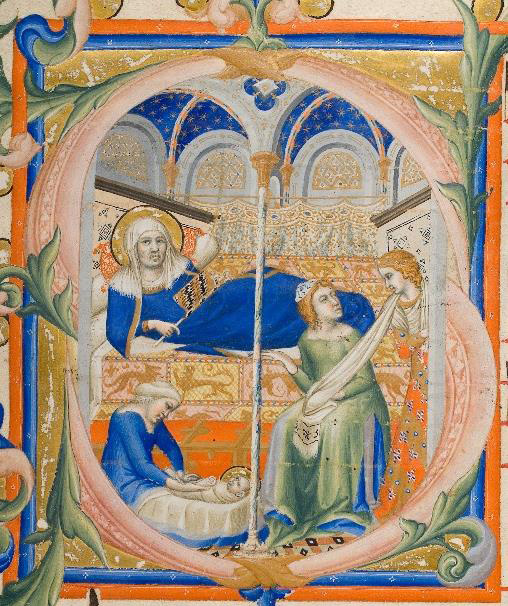
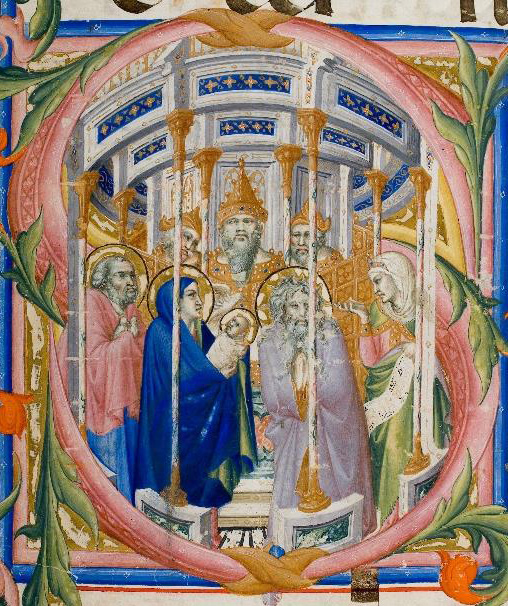
Freuler associates the Marriage of the Virgin with two other predella panels that must have belonged to the same ensemble: the Dormition of the Virgin formerly in the Lindenau‑Museum in Altenburg9 and the Crucifixion in the Museum der Universität in Göttingen.10
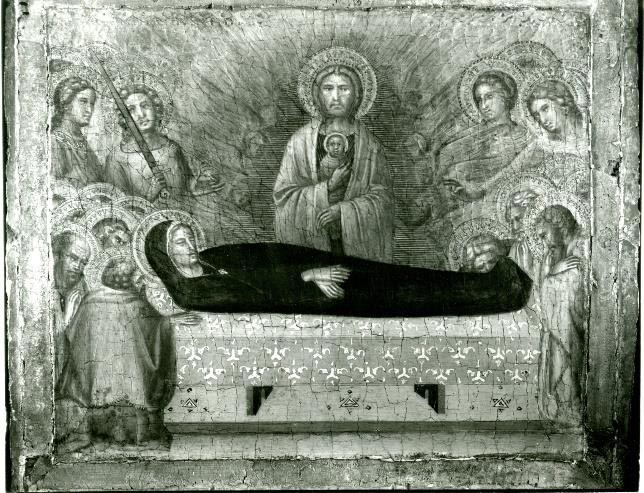
Lippo Vanni, The Death of the Virgin. Formerly Altenbourg, Lindenau‑Museum.

Lippo Vanni, The Crucifixion. Göttingen, Museum der Universität.
The two panels in Germany have long been identified as belonging to the same predella, to which we can now propose to add this Marriage of the Virgin. Both their style and dimensions (although the latter differ slightly) would indicate their shared origins. Above all, the Crucifixion in Göttingen shows a number of parallels with our Marriage of the Virgin. One can see the same features like the slightly harsh female profiles as well as the same concept of multiple figure groups achieved by layering either women’s headdresses or soldiers’ helmets.
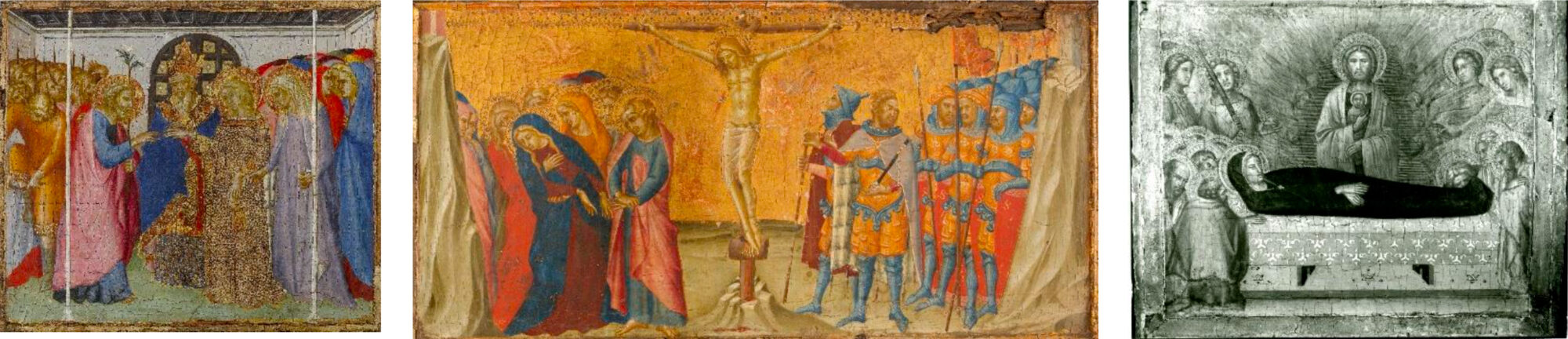
This predella, evidently dedicated to the life of the Virgin Mary, must have formed the lower part of a triptych, or more probably a polyptych. In the latter case, the predella would have comprised other panels, certainly including the Birth of the Virgin, preceding our panel, and perhaps (according to Freuler) the scene of her farewell to the Apostles, placed before the Dormition.11 Johannes Tripps put forward a later date in Lippo’s career, between 1350 and 1360, for the panels in Göttingen and Altenburg.12 However, the resemblance with the Santa Maria della Scala miniatures would support Freuler’s dating of around 1345.
Gaudenz Freuler also attempts to reconstruct the polyptych to which the predella originally belonged.13 He believes that only a few panels from this early point in his career could have come from larger altarpieces, and he cites a privately‑owned pinnacle panel of a beautiful Saint Peter, dated to about 1340‑1345 by Volpe14 and Chelazzi Dini15; a Virgin and Child formerly attributed to Ambrogio Lorenzetti but which Freuler suggested in 2009 was by Lippo Vanni16; and a damaged Saint Augustine, also in a private collection.17Freuler’s reconstruction of the polyptych thus includes these three panels as well as the three parts of the predella.

Lippo Vanni, Saint Peter, circa 1340–1345. Private collection.
G. Chelazzi Dini, « Lippo di Vanni », in L’Art gothique siennois, enluminure, peinture, orfèvrerie et sculpture, exhib. cat. (Avignon, musée du Petit Palais, June 26th–October 2nd, 1983), Florence, 1983, nº87, pp. 234–238.