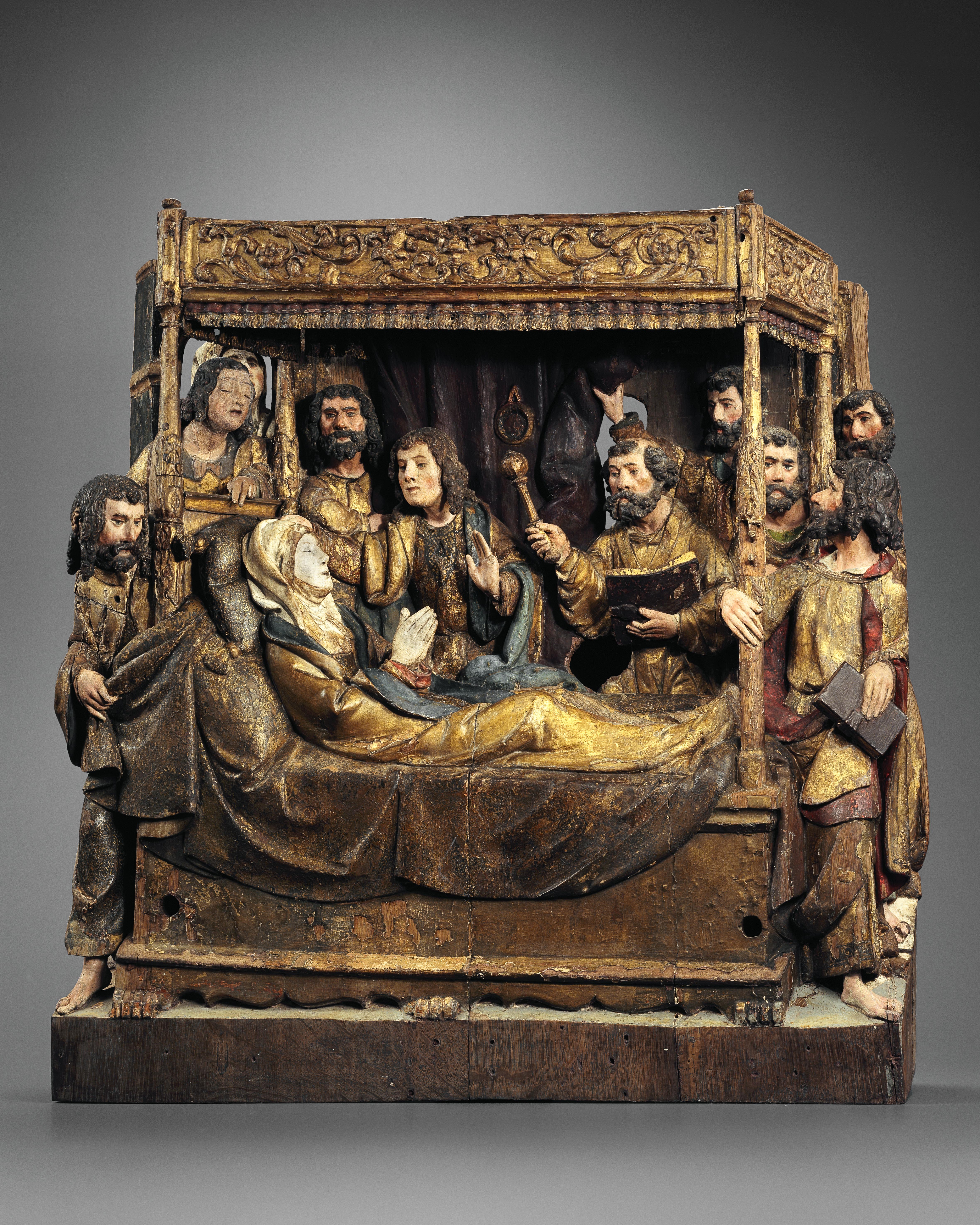
Element of an altarpiece: The Dormition of the Virgin
Northern France (Amiens) Circa 1520-1525
Provenance
Literature
Daussy, S., Autour de stalles et des reliefs sculptés du chœur et du transept de la cathédrale d’Amiens : les sculpteurs amiénois à la fin du Moyen Âge (1490–1530), PhD, Lille-3 University, under the direction of C. Heck, 2007, p. 1017.
Daussy, S., Sculpter à Amiens en 1500, Rennes, 2013, pp. 146–147, ill. 119.
Study
Lying on a sumptuous canopy bed covered by a brocaded sheet, the Virgin Mary is surrounded by the Apostles. Her upper body is supported by cushions, and her closed eyes and pallid features indicate that she is already deceased, even though she is represented with her hands joined in prayer. Among the Apostles surrounding her, one can recognise Saint John the Evangelist, who makes a blessing gesture as he gently leans towards her. In his right hand he would originally have held either a blessed candle or the palm branch of paradise. Next to him, officiating as priest, Peter holds an open Book of Scriptures and the aspergillum with which he sprinkles holy water onto the body of the Virgin. Nine Apostles are shown around her; two holes, located on either side of the base of the bed, suggest that two other Apostles would originally been seated below the Virgin’s bed, bringing the total number surrounding her to eleven. Each of them is given individuality, and their facial features and expressions vary from one to the other. Their shared sadness is perceptible: traces of polychromed tears can still be seen on some of their faces. Nonetheless, what they express remains contained, and their grief is devoid of pathos.
To the left of the group, under an arch, a veiled woman is visible. This figure, if we follow Louis Réau, could be one of the poor widows, friends of the Virgin to whom she had given two of her dresses. This follows the legend that became particularly popular because of the devotion to relics.1
Overall, the scene takes place within a space whose intimate character is further emphasised by the fact that it is scarcely larger than the bed itself. The curtain that closes off the composition reinforces this feeling of privacy while at the same time recalling a staging reminiscent of a Mystery Play. The detail of the little tondohanging on the drape accentuates the impression of a bourgeois interior of the kind favoured by Franco-Flemish artists at the end of the fifteenth and beginning of the sixteenth centuries, adding a touch of the picturesque, as does the detailed lacing on the curtain rod.
The composition of the group still has a truly Gothic language, though it is accompanied by decorative motifs in a more Renaissance idiom, such as the canopy and carved bedposts. This aspect, as well as the specific style of carving, works against the attribution of this altarpiece element to a Flemish sculptor. The assembly of the piece is atypical and has no true equivalent in Brabant; the structure is comprised of five principal sections. The back consists of three panels: the one on the left includes the veiled woman and the clean-shaven Apostle; the middle one has Saint John, Saint Peter and the two figures who draw the curtain; and the right-hand one cuts through one of these last two Apostles and includes the two other figures at the back of the composition. In front of the three rear panels are two pieces of wood with the body of the Virgin, the funeral bed and an Apostle on each side. The scene is composed of several other pieces: the bed canopy, embellished with fringes, is composed of three added panels and four colonnettes. Only two heads were carved separately, that of the Apostle on the far left, whose body thus forms part of the section with the upper part of the Virgin, and that of the clean-shaven Apostle, who is part of the left rear panel. Finally, other smaller items, such as the hand of the Apostle with the Book of Scriptures on the far right of the composition and the hand of the clean-shaven one resting on the top end of the bed, were also added. The figure group was certainly originally part of the central case of a large altarpiece.
Various altarpieces inspired by Brabantine models were created in the north of France, and our Dormitiongroup probably originated in that region. We may for example consider the large altarpiece from the old church of Bracheux, which is now in Beauvais Cathedral.2 But while the art of the Beauvais area shares elements of style with our piece, it is more likely that it was made in Amiens.
In her thesis of 2007 on the sculptures of the choir enclosures and transept of Amiens Cathedral and again in her volume of 2013, Stéphanie Diane Daussy proposed that this fragment of an altarpiece was created in the workshop that made the reliefs of the Temple of Solomon in the north arm of the cathedral transept.3 She suggests that this workshop can be identified with that of Antoine Ancquier, and indeed there exist convincing parallels between the Dormition group and the figures in the Temple of Solomon at Amiens: a tight, dense composition, the Renaissance ornamentation of the canopy, and the dislocated aspect of the postures.
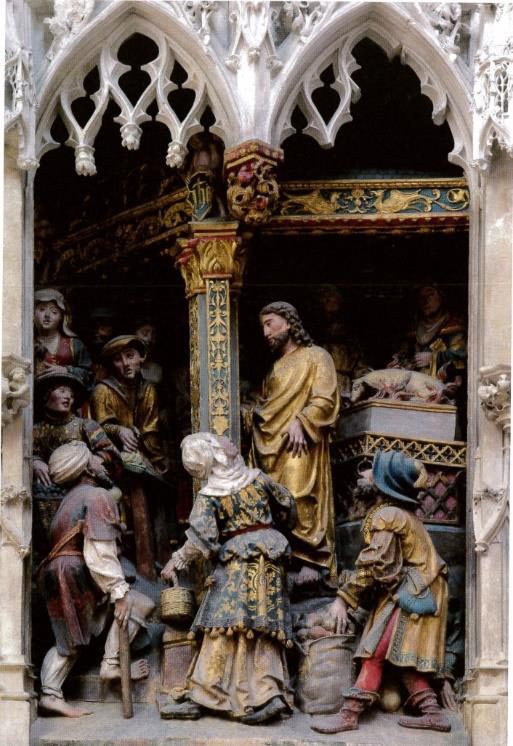
The elongated, bony appearance of the figures and the treatment of drapery, alternating solid areas of close-fitting fabric and long, sharp-edged folds, are also comparable. Above all, the figures in the two works share a very similar physical type: flattish faces with low foreheads, prominent cheekbones, plunging noses, small eyes close to one another, and protruding chins. These connections between the Dormition and the reliefs of the north arm of the transept in Amiens Cathedral thus make it possible to attribute the two carvings to the same workshop, which could be that of Antoine Ancquier, a sculptor who – to judge by his social prominence, achieved by 1514–15154 – must have received numerous commissions and enjoyed a certain fame.5
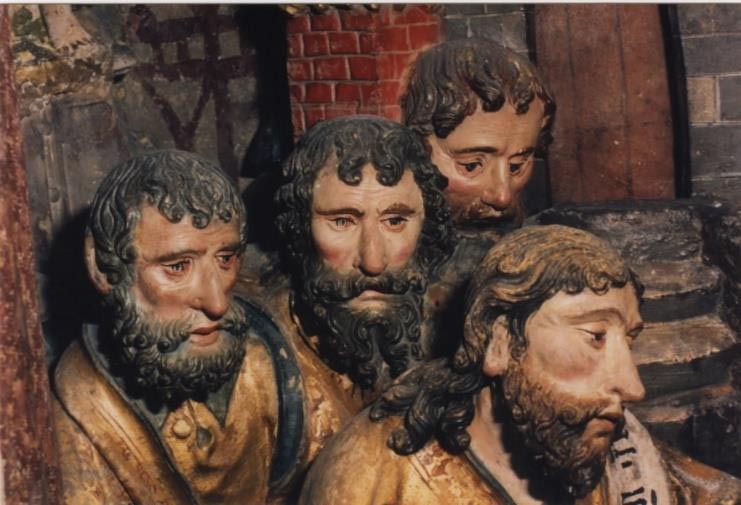
The Dormition of the Virgin now constitutes not only the sole instance of an altarpiece in Amiens dedicated to the life of the Virgin, but also the only example of a carved altarpiece attributable to this stylistic group of works.6
L. Réau, Iconographie de l’art chrétien, Iconographie de la Bible. II. Nouveau Testament, Paris, 1957, II, p. 608.
Ph. Bonnet-Laborderie, La Cathédrale Saint-Pierre. Beauvais. Histoire et architecture, Beauvais, 1978, pp. 214–215.
S. Daussy, Autour de stalles et des reliefs sculptés du chœur et du transept de la cathédrale d’Amiens : les sculpteurs amiénois à la fin du Moyen Âge (1490–1530), PhD, Lille-3 University, under the direction C. Heck, 2007, p. 1017; S. Daussy, Sculpter à Amiens en 1500, Rennes, 2013, Daussy, 2013, pp. 146–147, ill. 119.
S. Daussy, Autour de stalles et des reliefs sculptés du chœur et du transept de la cathédrale d’Amiens : les sculpteurs amiénois à la fin du Moyen Âge (1490–1530), PhD, Lille-3 University, under the direction C. Heck, 2007, part 2, I/B–2, b ; S. Daussy, Sculpter à Amiens en 1500, Rennes, 2013, pp. 146–147.