

Left wing of a diptych: The Adoration of the Magi Judging Christ workshop
Paris, circa 1300
Study
The scene of the Adoration of the Magi is placed under a three-lobed arch supported by consoles, surmounted by a gable with foliate crockets. The Virgin, seated on the right, holds the Child on her lap as he turns to the kneeling Magus and blesses him. This older Magus carries his crown on his left arm, offering the Child a golden disc in his right hand. Behind him, the youngest of the Magi holds a lidded vase, his left hand raised in a gesture of wonder. In the middle, the third Magus, also carrying a vase with a lid, points up to the star. Two angels, emerging from the heavens, appear within the arch. One places a crown on the Virgin’s head, while the other holds an incense boat in his left hand; he probably held a censer in his now broken-off right hand. Above the gable, set within a pair of quatrefoil medallions, the heads of a smiling young man and lady wearing a wimple look out from each corner.
Very close parallels exist between this diptych wing and another in the collection of the Musée du Louvre on long-term loan to the Musée de Cluny, which has a representation of the Crucifixion.1 Both pieces have the same type of three-lobed arch resting on consoles and topped by a gable with foliate crockets. In particular, the second wing has the same secular heads set over the gable in quatrefoils, and—making a more general comparison—the style of the two ivories is very similar. The wing in the Musée de Cluny forms a diptych with an Adoration of the Magi which has always been recognised as a nineteenth-century pastiche.2 It would therefore have been tempting to imagine that our wing was the pendant of the Cluny ivory, but the latter is larger, and the placement of what remains of the hinges does not correspond. Nonetheless it seems clear that the two wings were created in the same workshop.
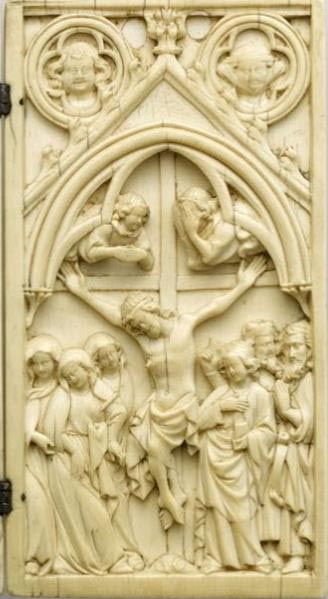
Right wing of a diptych: Crucifixion, Paris, circa 1300. Paris, Long-term loan from the musée du Louvre to the musée national du Moyen Âge, musée de Cluny.
As Danielle Gaborit-Chopin pointed out in reference to the Crucifixion, the very high quality of the carving and the smoothed-out style enable it to be compared with works in the so-called Judging Christ group.3Assembled around the Diptych of the Judging Christ in the Louvre4 the ivories are characterised by a soft and smooth, almost creamy modelling, rounded faces, full-bodied forms, graceful figures and a certain originality of iconography, reflected here in the two secular heads in the quatrefoils. According to Danielle Gaborit-Chopin, these two young faces are allegories of the Sun and Moon.5

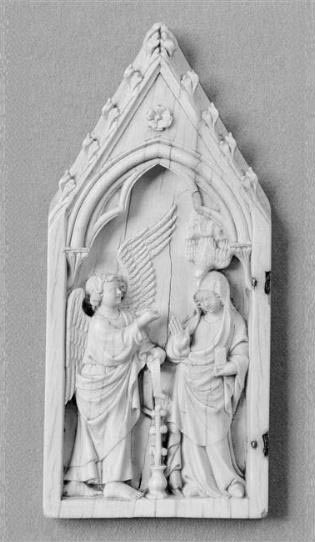

Wing of a polyptych: The Annunciation, Paris, circa 1300. Paris, musée du Louvre.
Fragment of a Crucifixion, Paris, circa 1300. The Cleveland Museum of Art.
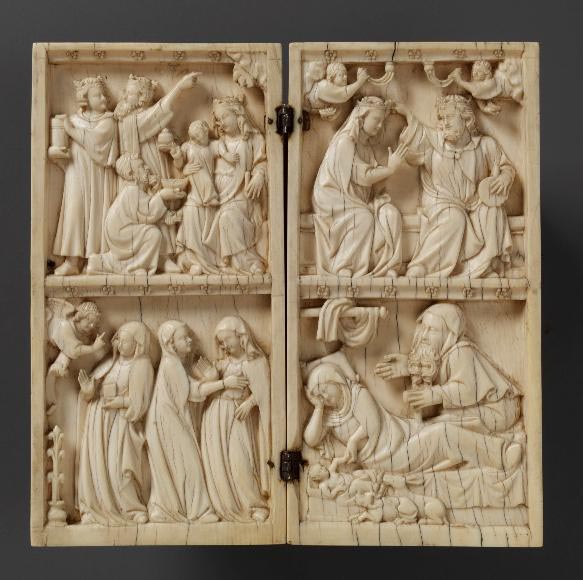
Among the ivories grouped around the Louvre diptych, we can cite three wings of a polyptych housed in Paris, London and Montpellier6, the diptych with Scenes from the Life of the Virgin in the Victoria and Albert Museum7, a wing with the Nativity and Coronation of the Virgin in the museum in Lyon8, and the fragment of a Crucifixion in the Cleveland Museum of Art.9
The ivories in this group all have the same fullness of form, smooth modelling, round, smiling faces, and drapery falling in supple, elegant folds. The close resemblance to the style of sculptures from Poissy has been pointed out on more than one occasion.10 Here, we may also note a possible association of the figure of the youngest Magus and the stone effigy of Pierre d’Alençon from the priory church of Saint-Louis de Poissy, now in the Musée de Cluny.11 Both figures have the upper part of the surcote defined only by vertical folds, which take on greater volume below, conveying the slight movement lent to the figure by the contrapposto pose.
The works in the Judging Christ group thus fully relate to the Parisian milieu of the 1300s, and – according to Danielle Gaborit-Chopin – mark a decisive stage in the evolution of Gothic ivory carving.12
R. Koechlin, Les Ivoires gothiques français, Paris, 1924, II, nº431, pp. 176–177 ; D. Gaborit-Chopin, Ivoires médiévaux Ve–XVe siècle. Musée du Louvre, Paris, 2003, nº266, p. 561.
D. Gaborit-Chopin (ed), L’Art au temps des rois maudits. Philippe le Bel et ses fils 1285–1328, exhib. cat. (Paris, Galeries nationales du Grand Palais, March 17th–June 29th, 1998), Paris, 1998, pp. 153–154, nº90 ; D. Gaborit-Chopin, Ivoires médiévaux Ve–XVe siècle. Musée du Louvre, Paris, 2003, pp. 347–348, nº125.
D. Gaborit-Chopin (ed), L’Art au temps des rois maudits. Philippe le Bel et ses fils 1285–1328, exhib. cat. (Paris, Galeries nationales du Grand Palais, March 17th–June 29th, 1998), Paris, 1998, p. 164; D. Gaborit-Chopin, Ivoires médiévaux Ve–XVe siècle. Musée du Louvre, Paris, 2003, p. 561.
D. Gaborit-Chopin (ed), L’Art au temps des rois maudits. Philippe le Bel et ses fils 1285–1328, exhib. cat. (Paris, Galeries nationales du Grand Palais, March 17th–June 29th, 1998), Paris, 1998, nº92, p. 156; P. Williamson and G. Davies, Medieval Ivory Carvings, 1200–1550. Victoria and Albert Museum, Londres, 2014, nº75, pp. 238–239.
D. Gaborit-Chopin (ed), L’Art au temps des rois maudits. Philippe le Bel et ses fils 1285–1328, exhib. cat. (Paris, Galeries nationales du Grand Palais, March 17th–June 29th, 1998), Paris, 1998, p. 153; D. Gaborit-Chopin, Ivoires médiévaux Ve–XVe siècle. Musée du Louvre, Paris, 2003, p. 348.
