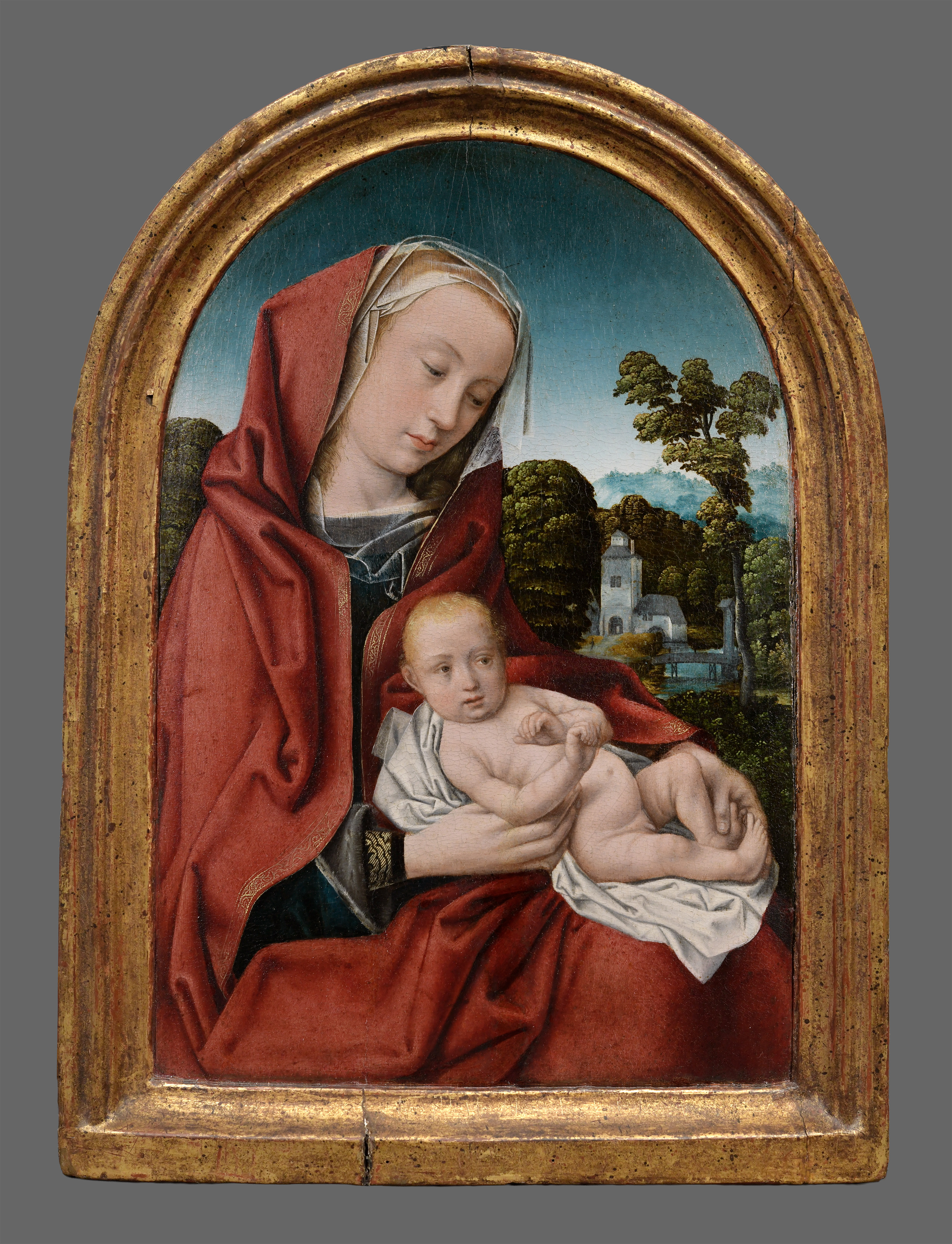
The Virgin and Child
Flanders (Antwerp), circa 1500
Provenance
Genoa, Bertollo collection, 1928; New York, with Silberman, 1951.
Literature
Study
Presented half-length, the Virgin is seated in the foreground of this composition, which she fills almost entirely in a tight close-up. She wears a midnight blue robe and ample red mantle, its hem decorated with fine gold embroidery. Under the fold of the mantle gathered around her head, she wears a transparent veil; on her lap she steadies the Christ Child, who is lying naked on a white cloth. Behind them, in the background, is a wooded landscape. On the right a stone building is visible beyond a body of water crossed by a bridge.
Friedrich Winkler was the first to note that the Virgin and Child precisely replicate the Holy Couple as seen in a panel of the Adoration of the Magi in the Metropolitan Museum of Art, New York.1 The latter is regarded as derived from a model by Hugo van der Goes, being either a free interpretation of the figures in the Monforte Altarpiece, painted in about 1470 and now housed in Berlin,2 or after another original but now lost composition by the master.3
The Adoration of the Magi in New York and the variant compositions derived from it have always been associated with the circle of the Master of Frankfurt, an artist active in Antwerp during the last quarter of the fifteenth century who was particularly influenced by Hugo van der Goes.
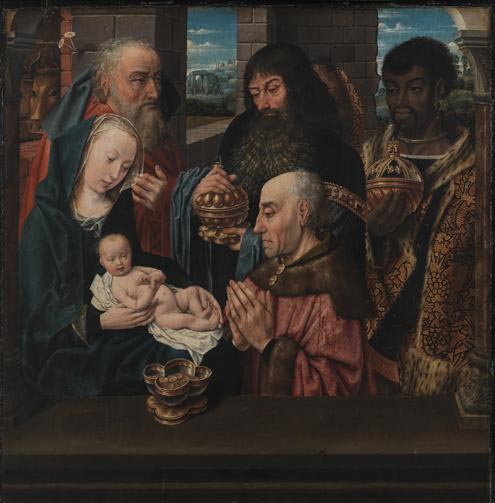
The adoption of the same motif in different compositions was therefore not a rare practice in Antwerp workshops, especially as regarded paintings destined for direct sale on the art market, without a specific commission. Another version of the New York Adoration of the Magi exists in the Statens Museum for Kunst, Copenhagen.4
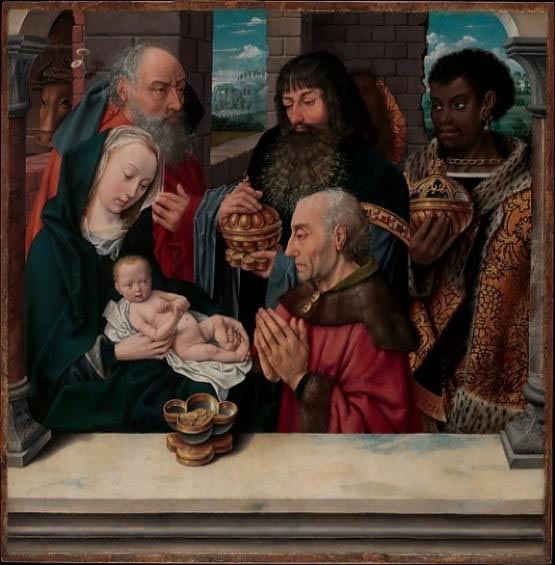
The Adoration of the Magi, Flanders, Antwerp, circa 1480–1500. New York, The Metropolitan Museum of Art.
The Adoration of the Magi, Flanders, Antwerp, circa 1480–1500. Copenhague, Statens Museumfor Kunst.
Likewise, there are several versions of the seated Virgin holding the Child on her lap. Among these, the one which is no doubt the closest to our composition is the Virgin and Child before a Landscape, a panel with an arched top formerly in the Campana collection and on extended loan from the Louvre to the museum in Bayeux.5 Another version was auctioned in New York by Sotheby Parke Bernet in 1978 and 1979.6 There, the Virgin is placed behind a parapet in the foreground, which supports a glass and some fruit, in a composition which directly recalls that of the Adoration of the Magi in New York and Copenhagen.
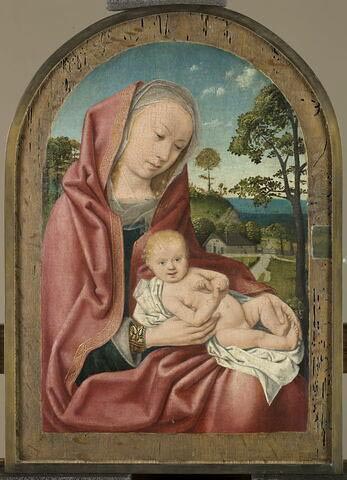
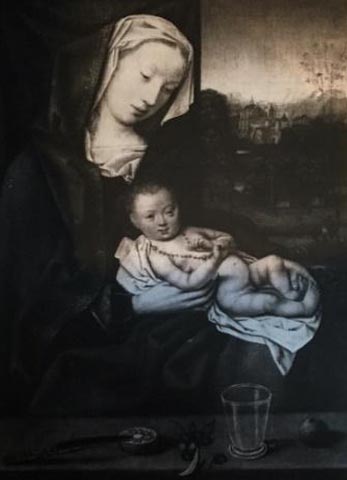
The Virgin and Child, Flanders, Antwerp, circa 1500. New York, Sotheby Parke-Bernet in 1978 and 1979.
In his study on the Frankfurt Master, Stephen Goddard suggested that the anonymous painter could be identified as Hendrik van Wueluwe, a member of the Guild of Saint Luke in Antwerp from 1483 onwards, who died in 1533. Goddard also attempted to distinguish different hands within the varied corpus of work attributed to the Frankfurt Master and his circle. Among these, he proposed that the Master of Watervliet—a close collaborator of the Frankfurt Master, named after the monumental Deposition triptych in the church of the Assumption in Watervliet (now in Belgium)7—as the author of the Adoration of the Magi in the Metropolitan Museum of Art and of the Virgin and Child behind a Parapet auctioned in New York in the late 1970s.8
M. J. Friedländer, Die altniederländische Malerei IV: Hugo van der Goes, Berlin, 1926, pp. 54–58, pp. 127–128, nº17, pl. XXVIII.
48 cm; W. 33.5 cm. Sotheby Parke Bernet, December 13th, 1978, lot 17; Sotheby Parke Bernet, December 12th 1979, lot 229; S. H. Goddard, « The Master of Frankfurt and his Shop », Verhandelingen van de Koninklijke Academie voor Wetenschappen, Letteren en Schone Kunsten van België, nº38, Bruxelles, 1984, p. 144, nº54.