

Medallion
Limoges, circa 1220
Study
Two small dragons face one another at the centre of the medallion, flanking a plant on whose branches they rest; they are winged, with an avian tail and long neck, and their bodies are entirely covered with chased stippling to give the sense of a lizard skin. Their eyes are made of dark blue enamel beads.
This central part, crafted in openwork repoussé copper, chased, engraved and gilded, is surrounded by blue enamelling with a continuous reserved and gilded foliate motif and four enamelled rosettes.
Now an isolated object, this openwork medallion must originally have adorned a travelling chest of the type owned by Cardinal Guala Bicchieri, housed in the Museo Civico, Turin1.The secular nature of the decoration, and in particular this type of fantastic creature from a bestiary, belongs to the customary repertory used in medallions adorning this kind of coffret. More specifically, the motif of a facing pair of animals, derived from Asian art and introduced in Western Europe by way of textiles, appears quite frequently in objects of this type, and such iconography tends to indicate its secular character. Nonetheless, there is evidence that a certain number of these chests had a function relating to an ecclesiastical context. The ones owned by Cardinal Bicchieri were used by him to store liturgical objects,2 while others could contain relics3.
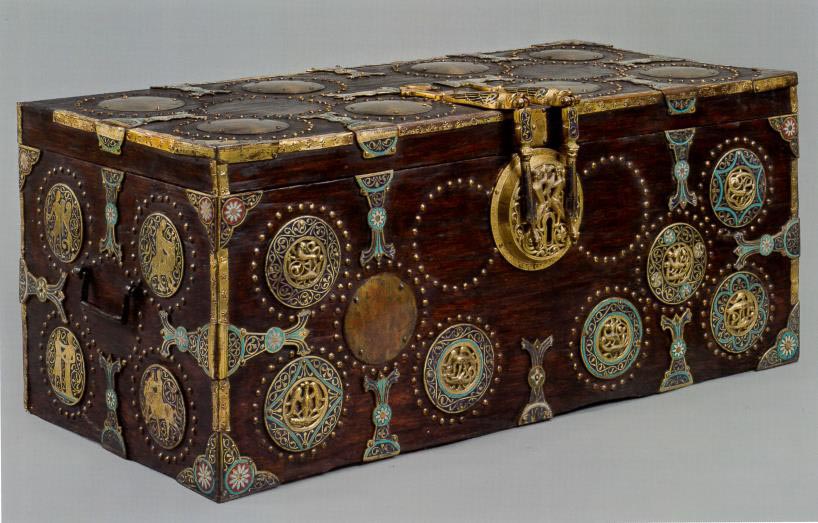
Chest of Cardinal Bicchieri, Limoges, before 1227. Turin, Museo Civico d’Arte Antica e Palazzo Madama.
É. Taburet-Delahaye and B. Drake Boehm (eds.), Enamels of Limoges, 1100–1350, exh. cat. (Paris, musée du Louvre, October 23th, 1995–January 22nd, 1996; New York, The Metropolitan Museum of Art, March 4th–June 16th, 1996), New York, 1996, pp. 282–285, nº88; S. Castronovo, Collezioni del Museo Civico d’Arte Antica di Torino. Smalti di Limoges del XIII secolo, Turin, 2014, pp. 102-115, no. 8; S. Castronovo and Ch. Descatoire, Les émaux de Limoges à décor profane. Autour des collections du cardinal Guala Bicchieri, exh. cat. (Paris, musée de Cluny, April 13th – August 29th 2016), Paris, 2016
