

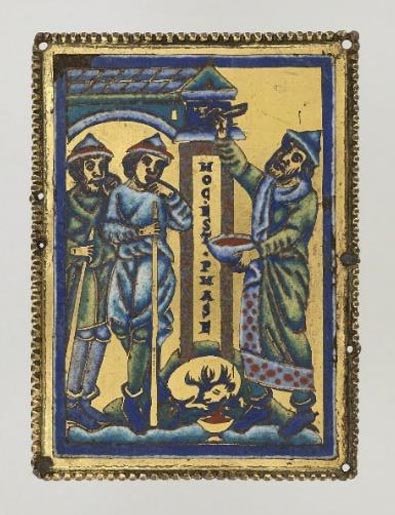
Plaque from a cross: The Sacrifice of the Lamb and sign of the Tau
Meuse Valley, circa 1160–1170
Provenance
Collection of E. Guilhou [1844–1912], Paris; collection of Simon Seligmann [1866–1927], Paris; collection of Georges E. Seligmann [1896–1998], New York.
Exhibitions
New York, Medieval Art from Private Collections, The Cloisters, October 30th 1968 – March 30th 1969, no. 148.
Literature
Verdier, Ph., “A Mosan Plaque with Ezechiel’s Vision of the Sign Thau (Tau) – Addendum”, Journal of the Walters Art Gallery, XXIX-XXX (1966-1967), p. 67.
Gomez-Moreno, C., Medieval Art from Private Collections. A Special Exhibition at The Cloisters, exh. cat. (New York, The Cloisters, October 30th 1968 – March 30th 1969), New York, The Metropolitan Museum of Art, 1968, no. 148.
Morgan, N., “The iconography of twelfth century Mosan enamels”, in Rhein und Maas, Kunst und Kultur 800-1400, II, Cologne, 1973, p. 265.
Pressouyre, L., “La ‘Mactatio Agni’ du portail des cathédrales gothiques et l’exégèse contemporaine”, Bulletin Monumental, vol. 132, 1974, pp. 58-59.
Verdier, Ph., “Émaux mosans et rhéno-mosans dans les collections des États-Unis”, Revue Belge d’Archéologie et d’Histoire de l’art, XLIV, 1975, pp. 34-35.
Brodsky, J. “Le groupe du triptyque de Stavelot: notes sur un atelier mosan et sur les rapports avec Saint-Denis”, Cahiers de Civilisation Médiévale, XXI, 1978, p. 108, note 24, pl. V, fig. 12.
Carlier, M.-A. “Plaque de croix typologique: Le sacrifice de l’Agneau et le Signe du Tau”, in George, Ph. (ed.), L’œuvre de la Meuse, Feuillets de la cathédrale de Liège, 2014, pp. 95-97.
Study
The dimensions and iconography of this plaque suggest that it may originally have formed part of a large typological cross. Frequently found in the region of the Meuse, such crosses expressed parallels between the Crucifixion, or Christ in Majesty, and various Old Testament episodes prefiguring either Christ’s sacrifice or the shape of the Cross, such as Abraham and Isaac, the Offerings of Cain and Abel, the Widow of Sarepta, or‑evidently‑the Sign of the Tau.
This learned taste for correspondences between Old and New Testaments, which spread through the Mosan region in an unprecedented way, is directly tied to the theories espoused by the theologians of the time. Among those in the forefront of the discussion was Rupert, a monk from Liège who became Abbot of Deutz in 1120. In his writings, Rupert of Deutz gives a wide‑ranging treatment of the Gospel story, reading it in symmetry with Old Testament narratives. These theological considerations profoundly marked the work of Mosan enamel artists, as one can see on numerous crosses or individual plaques from dismembered crosses.
The scene of Paschal immolation, in which the letter tau (T) is inscribed in lamb’s blood on the lintel of the doors of the Israelites as a sign of Salvation before the tenth plague of Egypt (Exodus 12: 21–22), is among the typological parallels frequently adopted in Mosan enamels. The subject appears in various examples, including the foot of the Cross of Saint Omer1, and on the crosses in the Royal Museum in Brussels2, the British Museum3, Vienna4, as well as on the reliquary cross in the Victoria and Albert Museum5, two related plaques in the Musée du Louvre6, and another plaque in the British Museum7.
Sometimes, as in the two related plaques in the Louvre, the scene of the anointing of doors with the blood of a lamb is presented as a pendant to that of the “man clothed in linen” who marks the Tau on the forehead of the righteous, according to the vision of the Prophet Ezekiel (9: 3‑4). The two iconographical subjects are very often associated, and generally present a conjunction of elements even when they are treated independently. As Philippe Verdier and Léon Pressouyre have underlined, the man inscribing the Tau on the front of a house—illustrating the passage from Exodus—does not use a sprig of hyssop dipped in lamb’s blood, as in the scriptural text, but a goose quill, as referred to in Ezekiel’s vision, and as seen here.

Passover with the Tau inscribed on a house, Meuse Valley, circa 1160‑1170. Paris, Musée du Louvre, département des Objets d’art.
Inscription of the Tau on the Foreheads of the Faithful, Meuse Valley, circa 1160‑1170. Paris, Musée du Louvre, département des Objets d’art.
On the present plaque formerly in the Seligmann collection, the sacrifice of the lamb is specified by the inscription “MACTATIO AGNI”, as on the Saint Omer crossfoot or the typological cross in Brussels. However, the slaughtering of the lamb is very often relatively inconspicuous, with the animal shown with its throat slit in the doorway of the house, its blood collected in a cup. Emphasis is given to the related image of anointing the doors with the blood of the lamb, indicated by the words “SIGNUM TAU” (once again drawn from Ezekiel), as in most of the other known instances. The subject is known in a number of variants in Mosan enamel art. The composition of the Seligmann plaque limits itself to the three essential elements of the story: the slaughtered lamb, the figure inscribing the sign of the Tau, and the house, which approximates the form of a church, with a gabled façade seemingly flanked by a pair of towers.

Cross, Meuse Valley, circa 1160‑1170. London, The British Museum.
The economy of means used in this image, and the choice of a beardless and simply clothed youth for the figure inscribing the Tau, invite direct comparison with the plaque on the right terminal of the typological cross in the British Museum, which can also be dated to the years between 1160 and 11708.
See COLOGNE‑BRUSSELS, Rhin‑-Meuse. Art et Civilisation 800–1400, exh. cat. (Köln, Kunsthalle, May 14th–July 23rd 1972 ; Brussels, musées royaux d’Art et d’Histoire, September 19th–October 31st, 1972), Cologne, 1972, pp. 254‑255, nºG17.
N. Stratford, Catalogue of Medieval Enamels in the British Museum, II, Northern Romanesque Enamel, London, 1993, cat. 4, pl. IX.
N. Morgan, « The Iconography of Twelfth Century Mosan Enamels », in Rhein und Maas, Kunst und Kultur 800‑1400, II, Köln, 1973, p. 264, fig.1.
