

Gregorio Di Lorenzo
Portrait of a Lady
Circa 1465–1475
Provenance
Collection of Michel Manzi [1849–1915] ; sale of his collection by his widow, Château de la Brosse, Chaumont-en-Vexin, 2 June 1929 ; collection of Joseph Altounian [1889–1954], Mâcon.
Literature
Caglioti, F., “‘Falsi’ veri e ‘falsi’ falsi nella scultura italiana del Rinascimento” in A. Ottani Cavina and M. Natale, eds., Il Falso specchio della Realtà, papers from Lo Specchio della Realtà. I Falsi e la Storia dell’Arte (study day, Federico Zeri Foundation, October 23rd–24th, 2013) , Turin , Allemandi, 2017, p.137, fig. 57, p. 156 note 75.
Study
A female profile stands out in significant relief from the flat background of this piece, its rectangular shape contoured on three sides by a fine moulding. Turned to the left, the lady fills almost all the space before her, while the empty space behind her head only contains two tresses, emerging from her flowing hair. She is coiffed with a slender ribbon which passes behind her ears and rises to the top of her head, where it is fastened by a fermaglio, a jewel found in numerous Florentine portraits of the second half of the fifteenth century. The lady is dressed in a rich velvet robe decorated with a floral brocade.
The creator of this relief, Gregorio di Lorenzo, long identified as the Master of the Marble Madonnas, was one of the most prolific Florentine sculptors of the second half of the Quattrocento.1 He was born in Florence around 1436, and his presence in Desiderio da Settignano’s workshop is attested to by a document from 1455. In 1461, he was registered as an independent master with the Arte dei Maestri di Pietra e Legname. In 1469, he owned a workshop in Piazza San Giovanni, behind the Baptistery. We know that in 1472, he transported thirteen of his works, a Virgin and twelve profiles of emperors, to Naples, apparently for the court of the kings of Aragon. Around 1475, probably fleeing creditors, he left his wife and children in Florence to settle at the court of Matthias Corvinus in Budapest, where he worked until at least 1485 and probably until the death of the King of Hungary in 1490. During the last decade of the fifteenth century, Gregorio seems to have worked itinerantly in Dalmatia and Urbino before resettling in Florence, where he is again registered with the Arte dei Maestri di Pietra e Legname from 1493 to 1497. His presence is also attested in Forli between 1502 and 1504, and he probably died shortly after that date.
The works created by Gregorio di Lorenzo during his half-century of activity are stylistically and qualitatively quite uneven, perhaps due to his travels, which must have led to collaborations with a wide variety of assistants.
In the artist’s career, this profile of a lady dates from his main period of activity in Florence, around 1465–1475. Stylistically, this profile of a woman can be compared to the series of profiles of emperors created by the sculptor, particularly for the courts of Naples and Ferrara in the early 1470s.2 The broad, rounded neck, the attention paid to the shape of the eyebrows, the rendering of the eyes and eyelids, the narrow, finely edged mouth, the rendering of the ear with its strongly prominent tragus, and the treatment of the relatively thick strands of hair allow us, despite a notable difference in scale, to compare this relief with the profiles of Caesar from the 1472 Ferrara series and, in particular, with the Hadrian preserved in the Louvre Museum.3
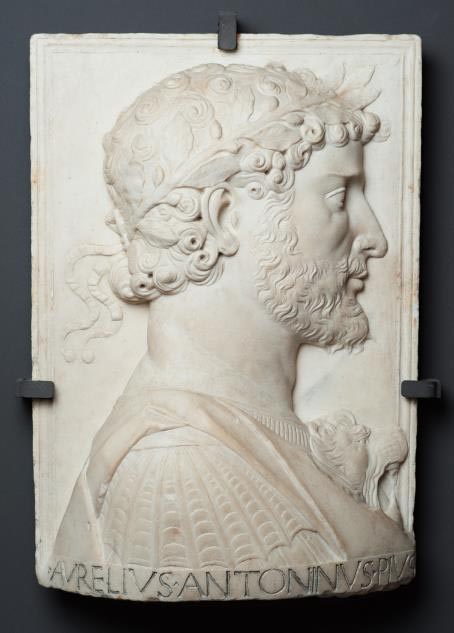

Gregorio di Lorenzo, Antoninus Pius, from the Torre del Rigobello of the Ducal Palace in Ferrara, 1472. Ferrara, Museo di Casa Romei
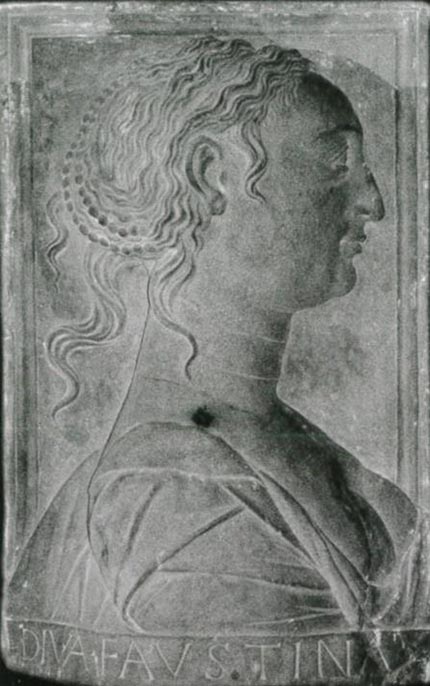

Gregorio di Lorenzo, Faustina, circa 1470–1480 (pietra serena, 59 cm high). Paris, Musée Jacquemart-André.
Furthermore, the treatment of the brocade dress, whose floral decoration stands out against a bumpy, velvet-like background, can also be seen in the Virgin and Child from the Palazzo Comunale in Pistoia, dated around 1460–1465.4 The treatment of the fabric that encircles the Virgin’s dress in this relief is also very similar to the thin ribbon in her hairstyle, to which the fermaglio is attached. These various similarities allow us to date the creation of this profile of a young woman to a relatively early stage in Gregorio’s career, probably around 1465–1470.
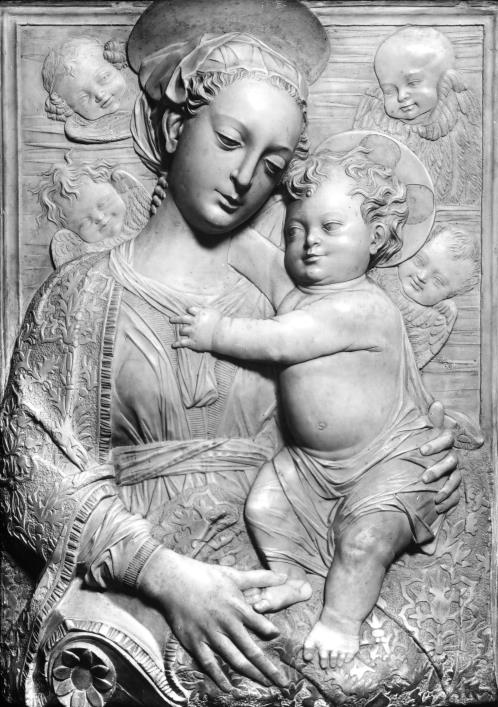

Gregorio di Lorenzo, Virgin and Child from the church of San Lorenzo degli Agostiniani in the Palazzo Comunale in Pistoia, circa 1460–1465 (marble, 77 × 56 cm). Pistoia, Museo Civico.
Gregorio di Lorenzo, Virgin and Child (detail) from the church of San Lorenzo degli Agostiniani in the Palazzo Comunale in Pistoia, circa 1460–1465 (marble, 77 × 56 cm). Pistoia, Museo Civico.
This datation invites us to compare this relief, following Francesco Caglioti, with another type of Florentine work from the same period: painted portraits of young ladies in profile.5 These portraits, inspired by the first portraits of this kind produced by Filippo Lippi in the years 1440–1445,6 constitute a very distinct typology in Florentine painting of the Quattrocento. The most characteristic, and undoubtedly the most famous, are the one by Alesso Baldovinetti, dated around 1465 and kept at the National Gallery in London,7 and the three portraits of ladies by Antonio and Piero del Pollaiolo, dated between 1465 and 1475, kept in Berlin, Milan, and New York.8


Alesso Baldovinetti, Portrait of a Lady, Florence, circa 1465, Londres, National Gallery.
Antonio et Piero del Pollaiolo, Portrait of a Lady, Florence, circa 1465, Berlin, Gemäldegalerie, Staatliche Museen zu Berlin.

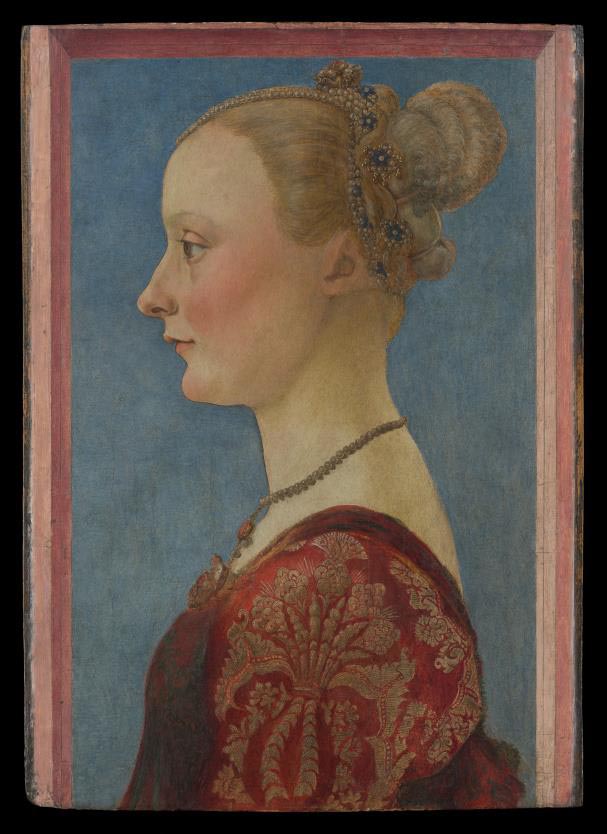
Antonio and Piero del Pollaiolo, Portrait of a Lady, Florence, circa 1465, Milan, Museo Poldi Pezzoli.
Antonio and Piero del Pollaiolo, Portrait of a Lady, Florence, circa 1470–75, New York, The Metropolitan Museum of Art.
In all these representations, particular attention is paid to clothing. The luxurious brocade dresses with floral motifs, particularly on the sleeves, most likely correspond to the wedding dresses worn by young Florentine ladies from prominent families in the 1460s and 1470s. Here, Gregorio focuses on rendering the contrast between materials, moving from a slightly bumpy texture reminiscent of velvet to a perfectly smooth finish for the artichoke flower decorations, probably made of gold or silver thread, which appear on the model’s sleeve and chest. Similarly, he takes particular care in rendering the gathering of the sleeve at the shoulder attachment.
Despite various attempts at identification, these portraits remain anonymous. However, it is widely accepted that these portraits, depicting young women in their most luxurious dresses, expertly coiffed and adorned with their finest jewelry, were most certainly commissioned for the models’ weddings. The extraordinary luxury and preciousness of these female figures’ attire suggest that they probably belonged to the most prominent Florentine families. Here, it might be tempting to link the pointed diamond adorning the fermaglio worn by the young woman to the Medici family, as one of the family’s emblems is a ring decorated with a diamond cut in this way. However, it is likely that this type of jewellery was not worn exclusively by members of this family, and the young lady in Gregorio’s relief, like her companions in the painted portraits, remains anonymous to this day.
On Gregorio di Lorenzo see A. Bellandi, Gregorio di Lorenzo. Il maestro delle Madonne di Marmo, Morbio Inferiore, 2010 ; A. Bellandi « Il contrappunto alla grazia : La formazione e la prima attività di Gregorio di Lorenzo « garzone » di Desiderio da Settignano » in J. Connors, A. Nova , B. Paolozzi Strozzi and G. Wolf (eds.), Desiderio da Settignano, Symposium Desiderio da Settignano (Florence May, 9th–12th, 2007), Venise, 2011, pp. 163–172.
A. Bellandi, Gregorio di Lorenzo, Il Maestro delle Madonne di Marmo, Morbio Inferiore, 2010, III.2.1. pp. 346–347.
F. Caglioti, « “Falsi” veri e “falsi” falsi nella scultura italiana » dans Anna Ottani Cavina et Mauro Natale (eds) Il Falso specchio della realità, [study day « Lo specchio della realità. I Falsi e la Storia dell’Arte » Bologne, Fondazione Federico Zeri, October 23rd–24th, 2013, Turin, Allemandi, 2017, p. 156, note 75.
D. Alan Brown (ed.) Virtue and Beauty, Leonardo’s Ginevra de’ Benci and Renaissance Portraits of Women, exhib. cat. (Washington, National Gallery of Art, September 30th, 2001–January, 2002), p. 92 ; K. Christiansen and S. Weppelmann, The Renaissance Portrait from Donatello to Bellini, exhib. cat. (Berlin, Bode Museum, August 25th–November 20th, 2011; New York, The Metropolitan Museum of Art, December 21st, 2011–March 18th, 2012), p. 14, fig. 4.
